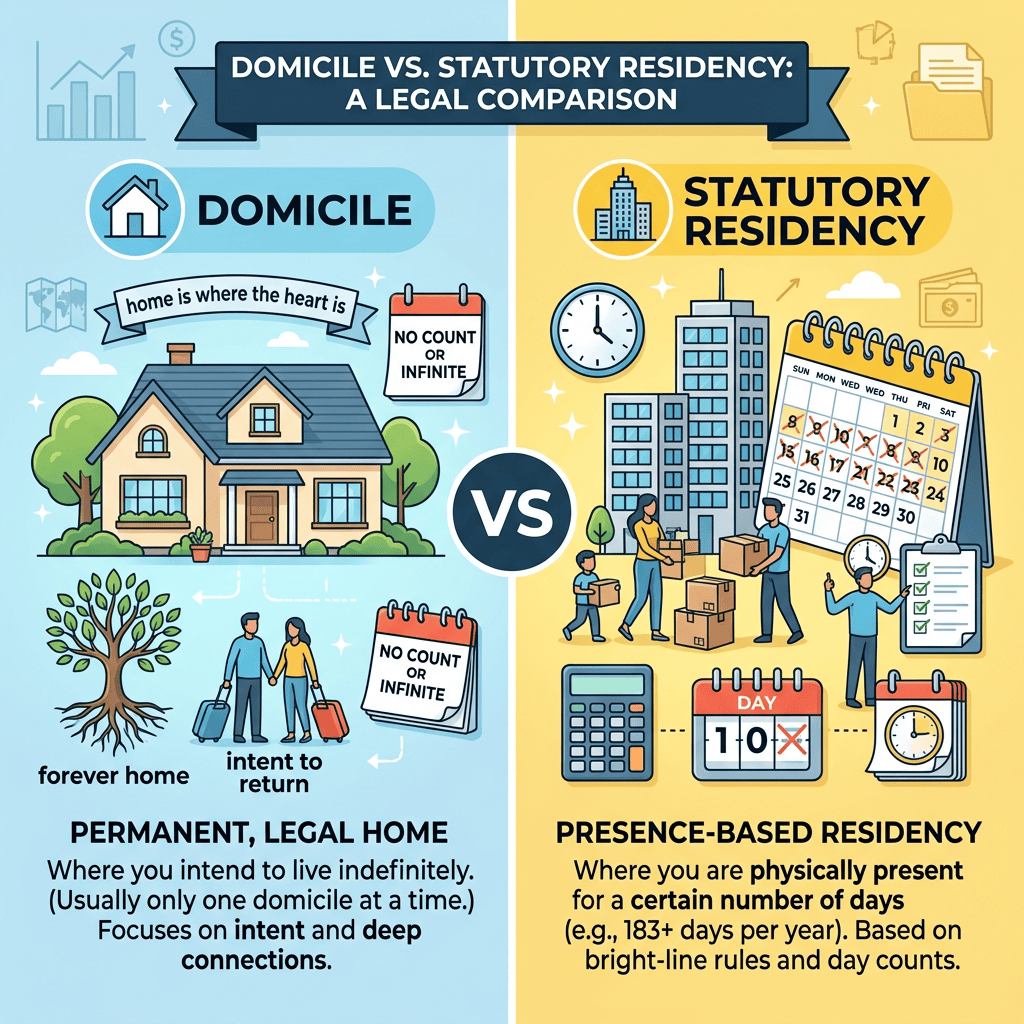
Most people think a state taxes you as a resident if you live there. In practice, many states have two separate ways to make you a resident, and you only have to meet one of them to owe tax on all of your income.
The first test is domicile. The second is statutory residency. Understanding the difference is the starting point for anyone who splits time between states, or who has moved and wants the move to stick.
Domicile: where you intend home to be
Your domicile is your true, permanent home. It’s the place you intend to return to whenever you’re away. You can own houses in three states, but you only have one domicile at a time.
Domicile is about intent, and because a state can’t read your mind, it looks at your actions. Typical factors include:
- Where your primary home is, and how it compares to any other homes you keep
- Where you work and run your businesses
- Where you spend your time
- Where your family lives
- Where you keep the things that matter most to you
Once you’re domiciled in a state, that domicile generally continues until you clearly establish a new one. The burden of proving a change usually falls on you, not the state.
Statutory residency: a test based on time and a home
Statutory residency doesn’t care about intent. In states that use it, you can be domiciled somewhere else entirely and still be taxed as a full resident.
A common version of the test, used by New York and several other states, has two parts:
- You maintain a permanent place of abode in the state for substantially all of the year, and
- You spend more than 183 days in the state during the tax year.
Meet both, and you can be treated as a resident even if your driver’s license, voting registration, and “real” home are in Florida. The exact rules differ by state, and some states don’t use a day-count test at all.
Why the difference matters
The two tests fail in different ways:
- Domicile cases are usually lost on intent. You moved, but kept your old doctor, your club membership, your kids’ school, and your best furniture in the old state. The state argues you never really left.
- Statutory residency cases are usually lost on proof. You believe you spent 175 days in the state, but you can’t show where you were on dozens of days. In many states, any part of a day counts as a full day, and a missing day can be counted against you.
If you’re leaving a high-tax state, you need a plan for both: actions that show your new home is your real home, and records that show where you were every day.
What to do with this
- Know which tests your current and former states use.
- Treat your domicile change as a series of deliberate, documented steps, not a single moving day.
- Keep a daily record of your location, with supporting evidence, from day one.
Domigo was built for exactly this. It records your location automatically, tracks the actions that show where home really is, and turns both into an audit-ready report for each state.
This post is general information, not tax or legal advice. Residency rules vary by state and change over time; talk to a qualified tax professional about your situation.


Leave a Reply